Monday, September 24, 2012

Guest Post: Finding Your Brand's Voice Through Social Media


Today we offer a guest guest post from Michael Kilcoyne, the Marketing Director at 360W3, a web design company that is finishing a refresh of our own site. Here, Michael explains how a brand's tone and style in play an important role in how customers relate to the brand.

Coined years ago by Alan Siegel, founder of Siegel + Gale, "brand voice" refers to the unique tone in which a brand typically communicates with its consumers. Creating an effective brand voice is a matter of discovering how a brand communicates when they are at their best.

Prior to social media, that communication generally came in just a few forms -- print, TV, radio, and perhaps web, but none were as always-on and involved as social media has quickly become.

Now, with the advent of social media, brands have been forced to rethink how they communicate with consumers, and to become far more willing in their communications. (And maybe that's why the notoriously secret Apple has generally avoided social media, for the most part.)

But discovering your  brand's voice doesn't have to occur through a series of increasingly complex brainstorms by the marketing department. Sometimes it's just as a simple as:

1. Listening to Your Audience
Although social media is frequently portrayed as medium that is rife with broadcasters (which works okay for someone like The New York Times), it's important for brands and individuals alike to actually pay attention to what consumers say about them through those channels.

According to a study by Socialbakers, last year, only around 5% of all wall posts that were posted on a brand's Facebook pages were responded to, even though a report by Arnold Worldwide recently indicated that nearly 60% of consumers expect to receive a response from brands regarding service. One shining example of a great listener is Whole Foods, a company that spends about 40 hours a week listening and responding to their consumers:


Beyond encouraging consumers to interact with your brand, listening to consumers can also help you find out who you're communicating with and how to best position your brand's voice to appeal to those consumers. Facebook already provides brands with an exceptional amount of information regarding their fans (including their age, gender, and location), but other channels like Twitter and Instagram require more research. The earlier that your brand asks questions like, "How do our consumers communicate with our brand? What do they like?" the more successful you'll be in crafting messages that align with those questions.

2. Telling Them What They Want to Hear
If your brand's target audience is teenage girls, you probably won't ask them about a UFC fight. Old Spice provides one of the best examples of a brand that has learned to cater to their target audience, providing an over-the-top, unconventional approach towards men's personal hygiene. What started off as peculiar (and extremely successful) has quickly crossed over into full-on strange territory, including Facebook updates like this:


Old Spice discovered that their consumers love this stuffand their social media successes have enabled them to craft a brand voice that isn't only unique in nature, but also something that people enjoy interacting with.

3. Maintaining A Consistent Tone
The biggest thing to take into account is the importance of maintaining a consistent tone. A communications guideline -- like this excellent example from designer eyewear company Warby Parker -- can help ensure that all of your brand's external communications positively reflect your company and your brand's unique voice so as not to confuse or put off consumers who have become accustomed to a particular tone.

Social media has enabled brands to be more human than ever, opening up a seemingly endless flow of conversation between consumers and brands. The most successful brands are the ones that are not only listening and actively engaged with their followers, but are also locked in on what their audiences want from a content standpoint.

Michael Kilcoyne is currently the Marketing Director at 360W3, a Westchester County-based web design company that specializes in website design and development, branding and social media marketing. Read more from him on 360W3's blog, or follow him on Twitter @mikekilcoyne.

Monday, September 10, 2012

Social Media Marketing Simplified


Monetize, optimize, reciprocity, and even, yes, engagement. Ever come out of a social media marketing planning session with your head spinning? This new frontier has created all kinds of vague buzzwords. Surely posting 140 characters isn’t as complicated as all those words imply?

Don’t let the jargon throw you. Marketing, branding, and selling on social media boils down to three basic questions:

1. Do people like you?
Meaning, do you have fans, followers, subscribers? The first step in a social media campaign is simply getting your target audience to find you. It doesn’t matter whether you’re trying to reach customers, donors, employees, job-seekers, or even a niche group like travel bloggers. You can’t get the results you want if no one knows you exist. Just posting and hoping isn’t enough.

How to be liked: Promote your social channels everywhere. Start online. Put links on your website, LinkedIn company page, and any of your personal social profiles. Encourage your leadership team and your employees to post them, too. Then hit the offline world. Your social channels should be on your business cards, in your brochures, on your recruitment materials, and, if you’re have a storefront, at your cash register and on your receipts.

Image via iMedia Connection
2. Are they responding?
We’ve all seen Facebook Pages that have thousands of Likes, but no comments. Once you’ve built a community (another buzzword that should be on the chopping block), you need to have a conversation.  If people are talking to you, it means they care about what your brand has to say. It’s OK if the first comments are complaints! Eventually you’ll get questions, ideas, and eventually, answers to your questions.

How to get ‘em talking: Show your audience that you’re listening by responding to comments right away, even if they’re complaints. Then post content that generates responses and shares. Social media expert Jeff Bullas (“guru” is forbidden!) has shown that photos, quotes, and infographics encourage interaction. Meanwhile, Social media scientist Dan Zarrella (a title he’s earned) found that humor often leads to sharing, as does content that’s useful or educational. The simplest way to get response is to just ask questions; Pepsi’s Facebook page often asks general questions like “What’s your favorite summer vacation?” or “What are your Labor day plans?” These relate to Pepsi’s spirit of food and fun, but don’t blatantly promote their products.


Conversation on T-Mobile's Facebook Page

3. Are they doing what you want?
Conversations are great, but you want results. Forget about terms like “return on investment” and ask the simple question: What do you want people to do? Buy your product, join your mailing list, apply for a job? It doesn’t matter if you have lots of fans or followers, or if they’re interacting with you, if you’re not ultimately getting the result you want. Likewise, a small fan base is all right, if they’re passionate and responding to your calls to action.

How to move them: Make every sixth or tenth post about your product or service; just enough to remind people but not enough to look like a sleazy salesman. Reward people who comment or share your content with special offers. Or go one step further (and Brandemix is great at this) and hold a sweepstakes, asking people to post photos, answer a trivia question, or vote on something in order to win a prize. Most importantly, be clear about what you’re asking, with simple statements like “Click here,” “Visit our website,” “Retweet to enter the contest,” or “Answer us in the comments.”

See? No need for obscure business terms. Just three simple questions. Of course, the answers can be more complex, and not every demographic reacts the same way to the same content. If you still need assistance, my agency can help your brand create a basic, straightforward social strategy – or simplify a campaign that’s gone off the rails. 

Just please don’t call me a guru.

PS: Want to take the SoMe Superstar challenger quiz? 
Then guess what these words mean: SoLoMo, Plussification. Answer in the comments -- if you dare.

Tuesday, August 28, 2012

Ready for a Mobile Site? Rethink Everything!

Based on a recent study by Mongoose Metrics, only 9% of all the websites in the world are optimized for mobile devices. And yet more and more people are viewing sites on smartphones and tablets. That means your site is probably failing a large part of your audience.

So you need to make your site mobile-ready. Think it’s easy? Nope. You have to rethink everything.

Rethink Design
A lot of clients I speak to think that “mobile optimization” means just shrinking their site to fit on a smaller screen. There’s much more to it. Because of the different needs of a mobile user and the different experience of a phone, the entire design has to change. This means bringing in your creative director (or using our fantastic one) to craft a new look and feel for the site, while keeping your branding. Seem like a big step? It’s only the beginning…

Rethink Navigation
Everything must be scaled down for a mobile site. Only the most important sections should remain, and they should all be prominently on the homepage. Compare the Famers Insurance website to its mobile site. The many options and documents have been reduced to just four items: reporting a claim, paying their bill, finding an agent, and browsing products. If you want to ensure users have access to more information, you can always include a link to your full site.

Farmers Insurance: From this...

...to this.

Rethink Text
There’s only so much room on a mobile screen, so try to keep text to a minimum. Most of the navigation should be done through buttons, large words, and clear icons. Look at AT&T's mobile careers site. Notice how they divide their departments by icons, with very small text below. On a “normal” website, these options could be simple text links. But for a mobile site, you should never make your visitors squint.

AT&T Careers emphasizes icons over text
Rethink Experience
See? The mobile experience is very different from a desktop one. Big graphic files or videos, which usually aren’t an issue, must now be weighed against the time it takes for them to load. Avoid Flash animation, since most mobile devices don’t currently support Flash. And different mobile operating systems are like different web browsers; what looks great on an iPhone may not look good on a Samsung Galaxy.

A great example of a totally “rethought” mobile site is Loews Hotels. The site uses the phone’s GPS to find the nearest hotel and offers four simple choices: Visit, call, map, or book now. Navigation on the homepage is a simple scrolling menu with photos, short descriptions, and buttons large enough for a thumb. Choosing “Contact Us” at the top offers the option to “Click here to book through a mobile device,” in case users missed it. It’s a clean, simple, informative mobile experience. No wonder it won the Web Marketing Association’s award for Outstanding Achievement in Mobile.

Loews Hotels' award-winning mobile site
 Want to learn more about creating a great mobile site? Use your smartphone as a phone (gasp!) and call us at 212-947-1001.

Monday, August 20, 2012

Employer Branding Numbers Everyone Should Know!

As experts in employer branding, we’re constantly researching the latest innovations and trends, and I’ve come across some recent recruiting studies that have some eye-opening findings. Think you don’t need an employer branding strategy? Read on.

88%
The percent of employees, out of 19,000 surveys and exit interviews, who leave an organization for reasons other than money. In that same survey, 89% of employers said they believed that employees left only because of money! (The Saratoga Institute)

What this means for you: You can compete even if you can’t offer top dollar. Generations X and Y consider many other factors, including culture, perks, flexibility, and corporate responsibility. If offering average pay and benefits is scaring you from reaching out to prospects, rest assured that your organization probably has one or more other strengths that will impress them.

60%
The percent of employees who would recommend jobs at their company to a close friend or family member — but employers say that only 23% of their employees participate in employee referral programs! (Bernard Hodes Group)

What this means for you: Organizations must do more to encourage their employees to refer talent. More than half your employees want to refer friends; they either don’t know how or don’t think about it when the opportunity comes. If you don’t have a referral program, you should create one. And if you have one, you should explore ways of getting information to your employees in a continuous, memorable way.

An employee referral program that Brandemix created for Kaplan
55%
Percent of employees, from more than 1,700 organizations worldwide, who believe “it’s important that other people want to work for my employer.” (Employer Brand International)

What this means for you: Employer branding isn’t just for recruiting; it can help retain talent, too. Just as employees leave for reasons other than money, they also stay for reasons like reputation and pride in work. Even if your recruiting is going somewhat smoothly, employer branding can help keep your current employees satisfied and productive, lowering your overall hiring costs.

51%
The percent of global employers, out of 632 surveyed, who believe that not having the right people had some effect on their companies’ losing business. (Universum EB Insights 2011)

What this means for you: Talent can be an unappreciated, overlooked, and under-funded resource. Some CEOs are familiar with cost-per-hire, but what about quality of hire? The wrong hire can cost more money than not hiring at all. In this economy, it may be easy to fill certain positions with warm bodies, but finding top talent who will lead the next generation of your company requires a compelling, differentiated message.

Image from Universum Employer Branding Insights 2011
3%
The percent of employers, out of a survey of 175 HR, communications, and marketing professionals, who said they had no employer branding strategy. 51% had an established strategy and most of the others were in the process of developing or refining theirs.(Bernard Hodes Group)

What this means for you: You must have an employer branding strategy. Presuming that you are an “employer of choice” with no need to engage job-seekers is no longer an option. Ninety-seven percent of your competitors are communicating their mission, vision, values, culture, and benefits to your talent pool; you have to get in the game or you’ll give away the victory.
 
-->
Interesting information, no? And here’s one more number: 33%. It’s the percent of companies that plan to increase their investment in employer branding. Are you one of them? Contact Brandemix for a free employer branding consultation.

Monday, August 13, 2012

Why Zappos is a Social Media Superstar

As many of you know from my speaking engagements and webinars, I’m always looking for brands that are using social media in innovative ways. I honor these organizations with the name “SoMe Superstars.” Past winners include State Farm and PepsiCo

Today I’d like to recognize a company that’s taken a fantastic brand and brilliantly expanded it into the social space: Zappos.

I’ve written about my love for Tony Hseih’s online shoe company before, but now it gives me great honor to truly call it a Superstar.

With more than 2,600 YouTube subscribers, 260,000 Facebook Likes, and almost 2.6 million Twitter followers (across seven accounts), Zappos has definitely made a social media splash. But lots of footwear and apparel companies appeal to young social media users. How does Zappos stand out? Here are a few reasons.

Website Videos – Instant, Honest, and Short
Zappos created a team of ten employees to make videos about every single one of its shoes. The videos are done on-site and are unscripted. Since starting the program in 2009, these employees have now created around 100,000 videos. They’re all under a minute, so that customers don’t get bored. Even better? Each video has three prominent sharing options – Twitter, Facebook, and HTML code for bloggers. The videos allow Zappos employees to share their love of the product and encourage customers to share their love on social media.


Social Recruiting, Too
Zappos offers a YouTube channel just for recruiting, with 33 videos. The content ranges from employee interviews to a look at the Zappos HQ fitness center to advice on how to dress for your job interview. This is a fantastic resource for job-seekers, with each video showcasing the spirit of fun and customer service that is the foundation of the Zappos brand. On Twitter, ZapposInsights and Inside_Zappos both offer a behind-the-scenes look at the company's unique culture, with lots of interaction with followers.


Their Own Personal Pinterest
The Zappos website has a unique feature that really makes it a superstar. It’s called the TweetWall; a collection of tweets from anyone who has linked to a Zappos product. It’s a form of crowdsourcing, where customers can see what styles have the most buzz. And instead of encouraging fans to tweet about the company, Zappos is rewarding fans for already doing it. Fans know this, and may tweet about Zappos just get a spot on the coveted wall.


Through YouTube, multiple Twitter profiles, employee videos, and the TweetWall, Zappos has created a virtuous circle: fans celebrate the brand because the brand recognizes the fans who celebrate it.
 

For sharing videos, tweets, and photos with their fans, and allowing their fans to share content in return, I name Zappos a SoMe Superstar!

Do you know of a brand that deserves superstar status? 
Drop me a line.

Tuesday, July 31, 2012

Brandemix Website Makeover Contest!

As Brandemix looks forward to the launch of our own new website (coming soon), it's time to recognize and celebrate great website makeovers!

We're holding a contest to reward the best refresh, revamp, and relaunch of websites (Click here for contest rules). Any organization, any size, profit or nonprofit.


Simply submit "before and after" images to website@brandemix.com and we'll post it the top ten judged entries on our Pinterest board during the voting period. 
Feel free to post as a web designer or a fan, even if you weren't responsible for the change. Don't have the "before"? Use the Wayback Machine. 

The redesign with the most total likes, comments, and repins will win a free press release, distributed to hundreds of outlets, announcing both the design achievement and the victory. 


We'll also capture the success and and those responsible for it on video, and post it here on our blog and 
our Facebook page. The whole world will learn all about the website and the brand.

What kind of things are we looking for? Here's the Lindal Group, a manufacturing company, before their website refresh:


Not bad, but heavy on text, and with no real branding. Navigation is on the left, the top, and the right, making for a confusing interface. Now look at the current site:


Much more visually interesting! Plenty of images of the products that Lindal actually makes. Clearer navigation and a search function to make browsing easier. And you've got to love the branding: "Your Innovation Partner." The previous website didn't have a tagline.

This and other website makeovers are on our contest pinboard on Pinterest. Vote by commenting, repinning, liking -- or all three! The website with the most total votes by Monday, September 17 wins the free press release, video interview, and eternal internet fame.

Submit your site, or any other, by emailing website@brandemix.com. Remember to include both a before and after shot.

Good luck!

Monday, July 23, 2012

When Brands Collide: What Happens to the Logo in an M&A?

Branding and marketing executives beware. Although this year has seen a precipitous fall off in M&A activity, economic signs point to a strong finish buoyed by signs of recovery in Europe.

Is your company a future hunter or prey? What might this mean to your brand?


“Historically, the decision on how to merge two large companies' brand identities and logos seems to have been made haphazardly,” write Ellen Sluder and Neil Wieloch of consulting firm CoreBrand“Rarely do companies take the time to consider how to [re-brand] most effectively.”

URLpulse compiled a gallery of “before and after” images of merger logos. It’s clear right away which companies tested and evaluated their new branding and which ones didn’t give it much thought.

In a Harvard Business Review article, Jonathan Knowles, Isaac Dinner, and Natalie Mizik recently showed that companies that “fuse” their two logos perform better financially than mergers in which one partner’s identity is discarded or both partners’ logos are maintained separately. So it’s better to be a logo united than one divided.


Speaking of united, 
many branding experts criticized the logo that resulted from last year’s merger of United Airlines and Continental Airlines. The new company kept United’s name and a very similar font, along with Continental’s blue globe icon. Basically nothing changed, and an opportunity to showcase a new, stronger airline was lost. Supporters claimed that changing signage at hundreds of airports all over the world and repainting two fleets of planes would cost millions of dollars. But what if the change was phased in? And how much money is the new, boring brand losing for the airline? Did the leadership examine all the options before they decided not to change anything?

Take it from the expert. Brandemix Creative Director Clarissa Zorr weighs in based on her own experience with merger logo design. “The brand design should take into consideration the reasons for the merger and what the new brand will stand for,” she told me. “Is it a paradigm shift, a hostile takeover, or are they simply joining forces?”

Good advice. So what are the “fused” logos that get it right? Verizon comes to mind. It’s the result of Bell Atlantic acquiring GTE. But you don’t see either of those companies’ logos, colors, or typefaces. The new company positioned itself as a 21st-century high-tech innovator totally unlike its old-fashioned parents.


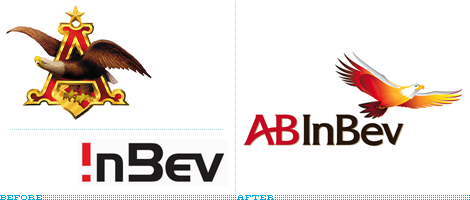
I also like the new AB InBev logo. It updates the 130-year-old Anheuser-Busch image and tones down the futuristic InBev font to create a new look that’s both classic and forward-looking.


The takeaway? Never overlook your branding. As Zorr says: “Time, budget, PR, and overall marketing efforts all play a role in the decision-making process.” A merger or acquisition can be exciting, tense, or even confusing for employees. Make sure they have a strong brand behind them and you’ll be on the path to success.

If you’re interesting re-branding your organization, talk to us. Been through a recent M&A? we’d love to hear from you.