Showing posts with label 2012. Show all posts

Wednesday, October 24, 2012

Recruit on Social -- Because That's Where The Job-Seekers Are


Jobvite just released their annual Social Job-Seeker Survey, which tracks social media use by people looking for work. The changes from last year’s survey are eye-opening. They show that social media is now a major part of talent acquisition -- and will only keep growing.
Jobvite talked to more than 2,000 adults. 60% were currently employed and 86% had at least one social media profile. One item that grabbed my attention was that only 318 of the 1,266 workers were not open to a new job; that means more than 60% of employees are willing to leave their current workplace.
Let’s get to the numbers:
16% of respondents said an online social network directly led to their current or most recent job. In fact, 15% said they found their favorite or best job on Facebook.
Social media is becoming a search engine for job-seekers. 34% of respondents say they’ve used Twitter to find work. 38% have used LinkedIn, while 52% have used Facebook. I’ve heard people joke that they only visit LinkedIn when they’re looking for a job, but apparently half the country isn’t going even that often.
Speaking of Facebook, 14% of respondents said they specifically “searched for jobs” on the network. 20% said a contact shared a job opportunity on Facebook. 9% used it to research an employer before or during the application process; how does your organization’s Facebook Page look to job-seekers?

In fact, we can look at Facebook from the recruiter’s point of view. Jobvite recently asked recruiters about content they found on candidates’ Facebook profiles. Their answers may affect job-seekers everywhere.
78% of recruiters had negative reactions to content involving drug use. 66% didn’t like sexual content and 61% didn’t like profanity. Even if you’re a sober, chaste, polite employee, you should proofread your posts – 54% of recruiters had negative reactions to poor spelling and grammar.
Content that generated the most positive reactions? Anything involving volunteer work or donating (66%) and membership in a professional organization (80%).
It’s clear that job-seekers are using social media to connect with recruiters, employers, and each other. They’re researching companies before they apply and updating their profiles with professional information. They’re even starting to search for jobs directly on social sites, which should give Monster and CareerBuilder something to think about.
If you’re interested in joining this exciting trend and recruiting on social media, Brandemix has plenty of experience. We’d love to hear from you.

Monday, August 20, 2012

Employer Branding Numbers Everyone Should Know!

As experts in employer branding, we’re constantly researching the latest innovations and trends, and I’ve come across some recent recruiting studies that have some eye-opening findings. Think you don’t need an employer branding strategy? Read on.

88%
The percent of employees, out of 19,000 surveys and exit interviews, who leave an organization for reasons other than money. In that same survey, 89% of employers said they believed that employees left only because of money! (The Saratoga Institute)

What this means for you: You can compete even if you can’t offer top dollar. Generations X and Y consider many other factors, including culture, perks, flexibility, and corporate responsibility. If offering average pay and benefits is scaring you from reaching out to prospects, rest assured that your organization probably has one or more other strengths that will impress them.

60%
The percent of employees who would recommend jobs at their company to a close friend or family member — but employers say that only 23% of their employees participate in employee referral programs! (Bernard Hodes Group)

What this means for you: Organizations must do more to encourage their employees to refer talent. More than half your employees want to refer friends; they either don’t know how or don’t think about it when the opportunity comes. If you don’t have a referral program, you should create one. And if you have one, you should explore ways of getting information to your employees in a continuous, memorable way.

An employee referral program that Brandemix created for Kaplan
55%
Percent of employees, from more than 1,700 organizations worldwide, who believe “it’s important that other people want to work for my employer.” (Employer Brand International)

What this means for you: Employer branding isn’t just for recruiting; it can help retain talent, too. Just as employees leave for reasons other than money, they also stay for reasons like reputation and pride in work. Even if your recruiting is going somewhat smoothly, employer branding can help keep your current employees satisfied and productive, lowering your overall hiring costs.

51%
The percent of global employers, out of 632 surveyed, who believe that not having the right people had some effect on their companies’ losing business. (Universum EB Insights 2011)

What this means for you: Talent can be an unappreciated, overlooked, and under-funded resource. Some CEOs are familiar with cost-per-hire, but what about quality of hire? The wrong hire can cost more money than not hiring at all. In this economy, it may be easy to fill certain positions with warm bodies, but finding top talent who will lead the next generation of your company requires a compelling, differentiated message.

Image from Universum Employer Branding Insights 2011
3%
The percent of employers, out of a survey of 175 HR, communications, and marketing professionals, who said they had no employer branding strategy. 51% had an established strategy and most of the others were in the process of developing or refining theirs.(Bernard Hodes Group)

What this means for you: You must have an employer branding strategy. Presuming that you are an “employer of choice” with no need to engage job-seekers is no longer an option. Ninety-seven percent of your competitors are communicating their mission, vision, values, culture, and benefits to your talent pool; you have to get in the game or you’ll give away the victory.
 
-->
Interesting information, no? And here’s one more number: 33%. It’s the percent of companies that plan to increase their investment in employer branding. Are you one of them? Contact Brandemix for a free employer branding consultation.

Monday, April 2, 2012

Insights from the BDI Social Consumer Conference

I recently attended the Social Consumer 2012 conference, presented by the Business Development Institute. Representatives from major brands discussed how they used social media to connect with customers. There were five fascinating presentations (and one entertaining interview, courtesy of the Wall Street Journal’s Simon Constable) followed by roundtable discussions hosted by experts in numerous fields. A very educational experience.

If you couldn’t attend, here are some highlights.


JetBlue on Twitter -- Drinking From the Fire Hose
Jenny Dervin, VP of Corporate Communications, called customer service on Twitter drinking from the fire hose.She gave a recent example of how JetBlue uses Twitter to handle complaints. A passenger had a carry-on bag that held a folding bicycle. The ticket agent ignored the fact that the bag was the proper size and weight for carry-on, and charged the passenger JetBlue’s standard bike fee -- meant for bikes that take up valuable space in the cargo hold. Unsurprisingly, the passenger complained about the fee on social media and got his Oregon-based bike club to join in. Dervin’s team saw the problem on Twitter and issued a refund within 24 hours. Now the entire bike club are JetBlue fans.

The Lesson: Dervin put it best: A service failure is an opportunity to build loyalty -- if it’s done well.When a customer has a problem, “you get credit for publicly saying We agree with you and we will look into this.’”

Fun fact: JetBlue has 15-20 people monitoring Twitter and other social media channels using CoTweet; six are on duty at any given time.


MultiVu -- Brands As Storytellers
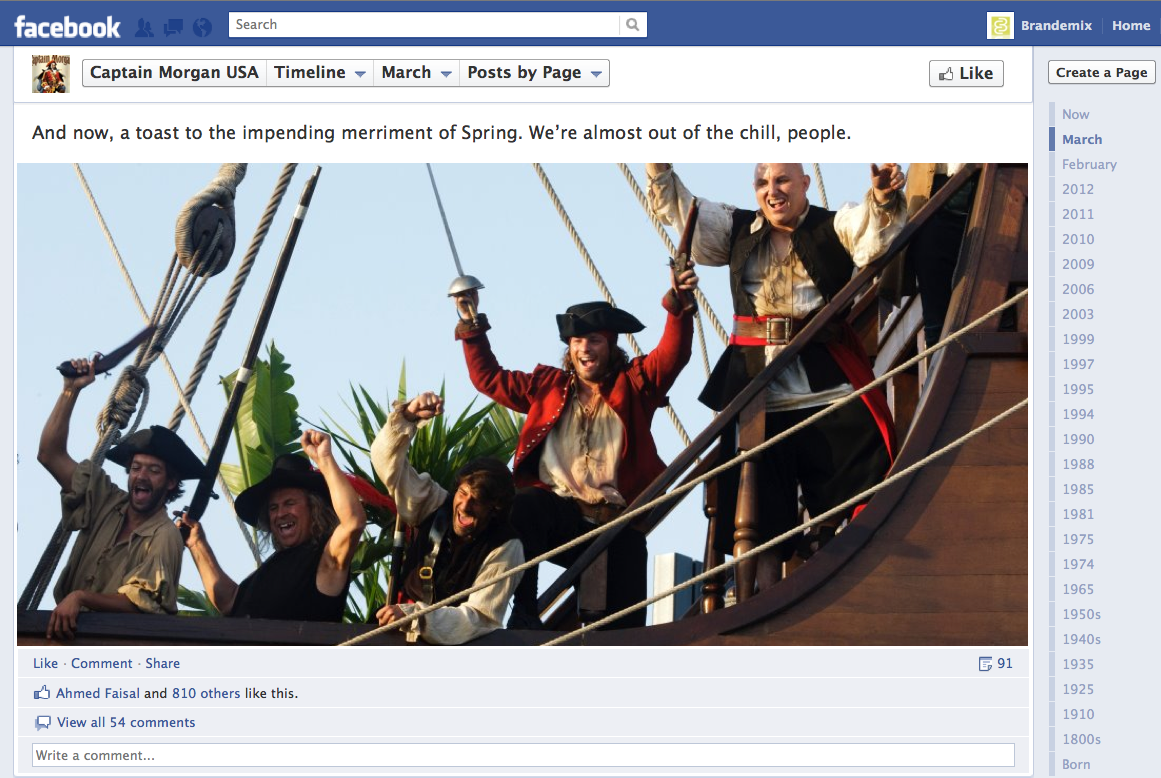
Tom Miale, Director of Multimedia Engagement at MultiVu, said that the #1 issue at this year’s South by Southwest Interactive was that brands must become storytellers to be compelling to customers. As an example, Miale presented the Facebook Page for Captain Morgan. The company uses the Timeline feature to post events all the way back to 1635, the real Morgan’s birthdate. In the 1800s section of the Timeline, you’ll find photos of Morgan’s crew, accompanied by jokes and stories in the captain’s sly tone. This is a fun and innovative way to take full advantage of the Timeline feature by creating stories that involve customers and keep them on your Facebook Page.

The Lesson: Not every brand has the adventurous history of a pirate. But you can still say a lot about your company and your product, from your humble beginnings to the challenges you’ve overcome. Your employees undoubtedly have interesting stories; ask to share them to help create a personal, emotional connection to customers. 

Fun Fact: Miale told us that, in 1965, three 60-second commercial spots could reach 80% of American adults. Today, youd need 117 commercials to accomplish that feat.


Tasti D-Lite Swirls Around Foursqaure
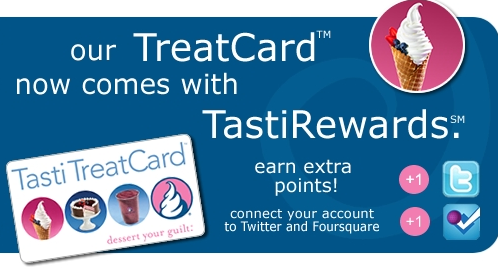
BJ Emerson, Vice President of Technology for Tasti D-Lite, may have been the hit of the conference -- and not just because he was giving out coupons. He showed how the frozen-treat company allows customers to connect their store TreatCards to Fourquare. When the clerk swipes the card, the customer is automatically checked in on Foursquare (which gets posted on Twitter and Facebook if the customer chooses). Emerson cautioned brands to “go beyond the mechanics and look at the dynamics. He cited an example of a Tasti cashier who knew to push the “Foursquare discount” button on the register, but didn’t know what the customer meant when she said “I’m actually the Mayor.” Our social media tools seem straightforward, but you have to make sure you train your staff how to use them in face-to-face situations with customers.

The Lesson: Emerson had the most retweeted line of the conference: Referring to the fact that brands now know where their customers are in real time, thanks to Foursquare and Twitter: “We used to call it stalking; now we call it location-based marketing.” Luckily, most brands are using that knowledge for good, by giving instant discounts and prizes.

Fun Fact: Emerson recommended creating a Google Alert for online mentions of your brand. Make that alert an RSS feed and send the feed to Outlook. That way, you have an offline archive of all your mentions and can search back through years. It’s more efficient than combing through the archives on Twitter or its various applications.

This was only a small part of the great information given by knowledgeable speakers. Thanks to BDI’s Sponsorship Event Coordinator Jennifer Brous, Director of Events Maria Feola-Magro, and CEO Steve Etzler for another informative conference.

Tuesday, August 16, 2011

Why Facebook Will Destroy LinkedIn


This week, the Wall Street Journal published a story by Joe Light that highlighted certain employers, such as Waste Management, finding more recruitment success on Facebook than on LinkedIn.
“Facebook hires account for less than 1% of the total hires companies are making,” Light noted, quoting Jobs2Web’s recent analysis. “But if current growth trends continue, Facebook could rival traditional job boards in 2012.”
But it isn’t just the job boards that should be worried; Facebook will destroy LinkedIn, too. Here’s why:
  • LinkedIn has 120 million members; Facebook has 750 million. Employers understand the concept of fishing where the fish are.
  • The perception that Facebook is made up of flaky teenagers while LinkedIn includes only business professionals is wrong; the two sites’ average ages are just two years apart (38 for Facebook, 40 for LinkedIn). So there are plenty of 30-somethings on Facebook with years of work experience who are considering a career change.
  • LinkedIn is under attack by a major job board. In June, Monster launched BeKnown, an application that turns Facebook into a recruiting platform. It has 760,000 active monthly users after just two months. Instead of joining forces with LinkedIn, Monster chose to bypass the professional site and ally itself with Facebook.
  • LinkedIn is also drawing fire from a startup. BranchOut, founded by former SuperFan CEO Rick Marini, is a similar application with 2.7million monthly users. Like BeKnown, BranchOut overlays employer information on top of the Facebook interface while shielding personal data (like embarrassing photos) from recruiters’ eyes. The success of these apps shows that millions of job seekers don’t want to leave their favorite website when looking for work.
  • LinkedIn can’t compete with Facebook’s social marketing. A major part of job searching involves personal references and word of mouth. Facebook is designed for just such interactions, as its “Recommended Pages” on a user’s home page shows. Instead of “Three friends like Pepsi,” users might soon see “Three friends applied to work at PepsiCo.” This sort of peer-to-peer marketing, effective in virtually every other field, will be impossible to duplicate on LinkedIn.
Facebook has more people, spending more time on the site, using innovative technology and getting personal referrals. LinkedIn has only its reputation and clean—bordering on empty—interface. I predict 2011 will be a tough year for the professional networking site. 2012 will be brutal. And, sometime in 2013, Facebook will finally destroy LinkedIn.