
Showing posts with label Rebranding. Show all posts
Showing posts with label Rebranding. Show all posts
Thursday, October 24, 2013
Brandemix Bonus Reel: Internal Communications Best Practices from Thomas Cook
Jason Ginsburg, Director of Interactive Branding at Brandemix, show how organizations can use Thomas Cook's philosophy in engaging employees during a re-branding.
To learn how Brandemix can help you with employee engagement and internal communications, visit our website.

Monday, May 6, 2013
The 6 Essential Steps to an Effective Brand Plan
The Brand Plan.
The first step in any successful branding or rebranding effort is the creation of the brand plan. The brand plan provides a roadmap for creating, marketing, launching and promoting your brand, and is relevant for both your internal and external activations.
The first step in any successful branding or rebranding effort is the creation of the brand plan. The brand plan provides a roadmap for creating, marketing, launching and promoting your brand, and is relevant for both your internal and external activations.
How do you create a brand plan? It can take months of research, discovery, analysis, and creative development, but here's a slimmed-down version to help get you started:
Start With a Vision
Your vision statement is aspirational. It’s about the future, not the present; it’s who you want to be as a company and where you want to be in the marketplace. It’s a goal that you will try to attain for the next three, five, or 10 years. Don’t be timid! A vision statement can be grand, bold, and optimistic. It should be an ideal worth aspiring to. This step involves research and discovery from everyone in the organization, as they’ll all be asked to contribute toward the goal.
Plan the Mission
The vision is where you want to be; the mission is how you get there. How will you achieve your goals and how will you know when you’re successful? At best, a mission statement also includes a brief version of your company’s philosophy and purpose. As Entrepreneur.com says, “Your mission statement doesn't have to be clever or catchy – just accurate.” Spend time fine-tuning every single word, since your mission statement will be your guiding principles for the life of your vision.
SWOT it Out
A brand plan includes an analysis of your company’s place in the market, broken down into four parts: Strengths – including your expertise, uniqueness, resources, or anything else that gives your company an advantage. Weaknesses – issues that may be holding you back from your potential; what knowledge or capabilities are you missing? Opportunities – such as an emerging customer need that you can meet, a new technology that will change your market, or a reduction in regulations or costs. Threats – problems on the horizon such as a customer need, technology, or law that make the market worse for your company.
Strategize Tactically
You now know where you want to go, how you’ll get there, and your current and future advantages and disadvantages. Now you can create a strategy that will help you get from here to there, using your strengths to take advantage of the opportunities and avoid the obstacles. This means creating a strategy, the large-scale plan for success. Within this are tactics, the individual programs, products, and initiatives that contribute to the strategy. In war, strategy involves which battles you’re going to fight; the tactics are how you fight them. Don’t get them mixed up or you can find yourself wasting resources on a tactic or overlooking the importance of a strategy.
Bring in the Numbers
Visions and missions can be “touchy-feely,” but a brand plan should include numbers. If you’re launching a new product, how many will be in your first shipment? What are your metrics for success – sales, hires, press mentions, social media responses? What’s the minimum ROI that will allow you to move on to the next step? And what’s the budget for each of your tactics? Don’t let your enthusiasm make you neglect the most important numbers – time and money!
3, 2, 1, Launch!
The plan is in place. Now it’s time to execute. Put that new budget to use and start designing, writing, creating, and activating. After so much discussion and preparation, everyone will be eager for results. Help them out with a quick win, an easily achieved goal that boosts your employees’ confidence and builds momentum for the next round. Quick wins silence doubters and give you something to point to at the first few status meetings and say, “This worked.”
Your brand plan is finished. Guided by your mission statement, you’re implementing your strategy and tactics, making your vision a reality. You’ve made some quick wins, you’re analyzing the metrics, and you’re aware of both the perils and the promise of the future. You’ve put in place a solid foundation for success.
At Brandemix, we specialize in brand planning, brand architecture, brand positioning, and branding initiatives. If you’d like to learn more, contact me. I’d love to share our knowledge with you.
Start With a Vision
Your vision statement is aspirational. It’s about the future, not the present; it’s who you want to be as a company and where you want to be in the marketplace. It’s a goal that you will try to attain for the next three, five, or 10 years. Don’t be timid! A vision statement can be grand, bold, and optimistic. It should be an ideal worth aspiring to. This step involves research and discovery from everyone in the organization, as they’ll all be asked to contribute toward the goal.
Plan the Mission
The vision is where you want to be; the mission is how you get there. How will you achieve your goals and how will you know when you’re successful? At best, a mission statement also includes a brief version of your company’s philosophy and purpose. As Entrepreneur.com says, “Your mission statement doesn't have to be clever or catchy – just accurate.” Spend time fine-tuning every single word, since your mission statement will be your guiding principles for the life of your vision.
 |
| It's all right to have your head in the clouds when writing your vision and mission. |
A brand plan includes an analysis of your company’s place in the market, broken down into four parts: Strengths – including your expertise, uniqueness, resources, or anything else that gives your company an advantage. Weaknesses – issues that may be holding you back from your potential; what knowledge or capabilities are you missing? Opportunities – such as an emerging customer need that you can meet, a new technology that will change your market, or a reduction in regulations or costs. Threats – problems on the horizon such as a customer need, technology, or law that make the market worse for your company.
Strategize Tactically
You now know where you want to go, how you’ll get there, and your current and future advantages and disadvantages. Now you can create a strategy that will help you get from here to there, using your strengths to take advantage of the opportunities and avoid the obstacles. This means creating a strategy, the large-scale plan for success. Within this are tactics, the individual programs, products, and initiatives that contribute to the strategy. In war, strategy involves which battles you’re going to fight; the tactics are how you fight them. Don’t get them mixed up or you can find yourself wasting resources on a tactic or overlooking the importance of a strategy.
Bring in the Numbers
Visions and missions can be “touchy-feely,” but a brand plan should include numbers. If you’re launching a new product, how many will be in your first shipment? What are your metrics for success – sales, hires, press mentions, social media responses? What’s the minimum ROI that will allow you to move on to the next step? And what’s the budget for each of your tactics? Don’t let your enthusiasm make you neglect the most important numbers – time and money!
 |
| Some brand plans are measured in months; others in hours |
3, 2, 1, Launch!
The plan is in place. Now it’s time to execute. Put that new budget to use and start designing, writing, creating, and activating. After so much discussion and preparation, everyone will be eager for results. Help them out with a quick win, an easily achieved goal that boosts your employees’ confidence and builds momentum for the next round. Quick wins silence doubters and give you something to point to at the first few status meetings and say, “This worked.”
Your brand plan is finished. Guided by your mission statement, you’re implementing your strategy and tactics, making your vision a reality. You’ve made some quick wins, you’re analyzing the metrics, and you’re aware of both the perils and the promise of the future. You’ve put in place a solid foundation for success.
At Brandemix, we specialize in brand planning, brand architecture, brand positioning, and branding initiatives. If you’d like to learn more, contact me. I’d love to share our knowledge with you.
Wednesday, January 23, 2013
Monday, December 3, 2012
Four Steps to a Successful Rebranding
You’ve read my blog post “Four Signs You’re Ready to Rebrand” and realized it’s time for a rebranding. Now what?
It’s important to have a well-executed,
well-timed strategy that generates the most buzz from all audiences – both
internally externally. A bad launch can undo much of the hard work you put into
the rebranding itself.
Here are four steps to ensure your rebranding is successful.
1. Announce the Change
Every one of your channels and materials should
announce the new name, logo, focus, or services. That includes your website,
your email signatures, your newsletter, and your blog. Make it clear that your
operations won’t be interrupted and that current customers have nothing to
worry about. Give a link or email address where customers can ask questions.
I also recommend a press release distributed through PR Newswire or free services like Online PR News and Newswire Today. Here you can go into more detail about the how and why of the rebranding. Accentuate the positive and promise there will be no problems with customer service or product offerings. Include quotes from your CEO. And press releases are great for SEO – especially if you’re changing or adding keywords to your brand.
I also recommend a press release distributed through PR Newswire or free services like Online PR News and Newswire Today. Here you can go into more detail about the how and why of the rebranding. Accentuate the positive and promise there will be no problems with customer service or product offerings. Include quotes from your CEO. And press releases are great for SEO – especially if you’re changing or adding keywords to your brand.
2. Change Your Social Media
If you’re rebranding is just in the form of a
new logo and tagline, it’s pretty easy to change your social channels’ profile
pictures, icons, and “About Us” copy. But if you changed your name or even your
focus, get ready for more of an overhaul.
You can change your Twitter name at anytime,
but your Facebook Page URL can only be changed if you have less than 100 likes.
You can request a change from Facebook directly or simply create a new Page,
encouraging your fans to follow you there. Then taper off your posting on the
original Page.
As for YouTube, don’t worry about uploading all
your videos to a new account. Though you can’t change your username, you can
create a vanity URL that directs viewers to your original YouTube channel. Personal
Pinterest usernames and Google+ names can be changed with only a few clicks.
The hardest site to alter your name? LinkedIn, which requires a special email request.
 |
| A great example of a blog post explaining a company's rebranding |
3. Make Corrections in the Field
Personally inform any blogs or publications
that have covered you or listed you of the rebranding.
Do a search for your brand. If you see it
mentioned in a blog or message board, write a comment that notifies readers of the
rebranding. It can be as simple as “Kentucky Fried Chicken is now KFC.”
Informative without being too promotional.
In fact, you can even enlist your employees. We
once worked with a major financial client that held a contest, giving a prize
to any worker who found an example of its old logo anywhere on its websites.
4. Do a Final Sweep
Make sure your partners, clients, and vendors
are aware of the change and have your new branding on all their materials. Shut
down or redirect any legacy sites or links that may confuse your customers. Make
sure your Google AdWords or Facebook Ads accounts have your new keywords.
Search several pages deep into search engines to see if there’s any website you
missed.
Of course, there’s always a small chance that
the public won’t respond to your new branding. Look at what happened when the
Gap changed its logo. The same thing is
happening to JCPenney – but the Gap had the sense and humility to switch
back
As our name implies, Brandemix specializes in
branding, rebranding, and employer branding. If the process seems overwhelming,
or you’re ready for a major change, we’d love to get into the mix!
Monday, July 23, 2012
When Brands Collide: What Happens to the Logo in an M&A?
Branding and marketing executives beware. Although this year has seen a precipitous fall off in M&A activity, economic signs point to a strong finish buoyed by signs of recovery in Europe.

Is your company a future hunter or prey? What might this mean to your brand?

“Historically, the decision on how to merge two large companies' brand identities and logos seems to have been made haphazardly,” write Ellen Sluder and Neil Wieloch of consulting firm CoreBrand. “Rarely do companies take the time to consider how to [re-brand] most effectively.”
In a Harvard Business Review article, Jonathan Knowles, Isaac Dinner, and Natalie Mizik recently showed that companies that “fuse” their two logos perform better financially than mergers in which one partner’s identity is discarded or both partners’ logos are maintained separately. So it’s better to be a logo united than one divided.

Speaking of united, many branding experts criticized the logo that resulted from last year’s merger of United Airlines and Continental Airlines. The new company kept United’s name and a very similar font, along with Continental’s blue globe icon. Basically nothing changed, and an opportunity to showcase a new, stronger airline was lost. Supporters claimed that changing signage at hundreds of airports all over the world and repainting two fleets of planes would cost millions of dollars. But what if the change was phased in? And how much money is the new, boring brand losing for the airline? Did the leadership examine all the options before they decided not to change anything?

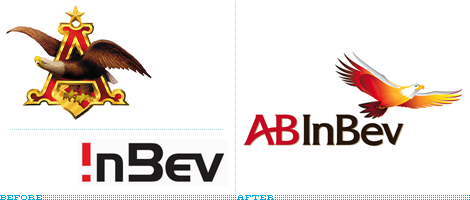
I also like the new AB InBev logo. It updates the 130-year-old Anheuser-Busch image and tones down the futuristic InBev font to create a new look that’s both classic and forward-looking.

URLpulse compiled a gallery of “before and after” images of merger logos. It’s clear right away which companies tested and evaluated their new branding and which ones didn’t give it much thought.
Speaking of united, many branding experts criticized the logo that resulted from last year’s merger of United Airlines and Continental Airlines. The new company kept United’s name and a very similar font, along with Continental’s blue globe icon. Basically nothing changed, and an opportunity to showcase a new, stronger airline was lost. Supporters claimed that changing signage at hundreds of airports all over the world and repainting two fleets of planes would cost millions of dollars. But what if the change was phased in? And how much money is the new, boring brand losing for the airline? Did the leadership examine all the options before they decided not to change anything?
Take it from the expert. Brandemix Creative Director Clarissa Zorr weighs in based on her own experience with merger logo design. “The brand design should take into consideration the reasons for the merger and what the new brand will stand for,” she told me. “Is it a paradigm shift, a hostile takeover, or are they simply joining forces?”
Good advice. So what are the “fused” logos that get it right? Verizon comes to mind. It’s the result of Bell Atlantic acquiring GTE. But you don’t see either of those companies’ logos, colors, or typefaces. The new company positioned itself as a 21st-century high-tech innovator totally unlike its old-fashioned parents.


The takeaway? Never overlook your branding. As Zorr says: “Time, budget, PR, and overall marketing efforts all play a role in the decision-making process.” A merger or acquisition can be exciting, tense, or even confusing for employees. Make sure they have a strong brand behind them and you’ll be on the path to success.
If you’re interesting re-branding your organization, talk to us. Been through a recent M&A? we’d love to hear from you.
Tuesday, May 22, 2012
Non-Profit Branding: Yes, There is a Difference
-->


My company has been working
with several non-profits
lately, and I’m constantly asked how branding in that space is different from “regular” branding. There are similarities, but also some important
differences. Here’s what non-profits need to know about branding, based on my
experience and research.
We start with “free.”
I understand that non-profits don’t have the marketing budgets of corporations so we start by leveraging every
existing asset. Rather than creating new social media channels, how can we
enhance the channels you’re already on? How can we repurpose your photos and
videos? What are some past concepts or campaigns that could be revived with a
compelling new angle? My fantastic staff and I have a knack for finding
creative ways around limited budgets. For example, we’ve taken a stack of
photos and turned them into a beautiful, moving slide show.

Talk to both the head and
the heart.
Unlike
other brands, non-profits aren’t selling a product or service; you’re selling a
cause or a belief or a goal, which can sometimes be hard to define or quantify.
This requires creating an emotional bond to donors, employees, and the people
(or animals!) you serve. It is important to research that bond, deconstruct it, and examine it
from every angle – and articulate it as your brand. As an example, see the World Wildlife Fund, which pairs its logical
mission, “To conserve nature and reduce the most
pressing threats to the diversity of life on Earth” with an emotional image,
the giant panda.
Stay true to yourself.
As Nathalie Kylander and
Christopher Stone point out in their recent study, non-profits run the risk of violating their own
ethics or identity when they brand to a wide audience. They give the example of
Acumen, which presents photos of proud, dignified individuals
instead of pitiful images of poverty which “dehumanize the very people Acumen
is trying to help." I discourage branding from vanity, or because you just want
a new logo. Branding is about the heart and soul of your organization and can’t
be taken on and off like a shirt.

Tell a story
Storytelling was the #1 topic at SXSW and it works for non-profits as well. A strong brand
is supported by good stories which allow people to connect to your mission.
Brandemix helps non-profits find those stories, whether they’re about important
milestones in your history, the life and deeds of your founder, or the success
stories of the people you’ve helped. For example, the
Sierra Club offers a blog called Explore, which features “stories of personal encounters with the natural
world.” This turns large, complex issues, like hydraulic natural gas
fracturing, into personal stories of triumph, wonder, and survival.
Non-profit
branding is different from other types and requires a specialist. Brandemix has
a history of giving back to the community by partnering with organizations such
as the Epilepsy Foundation of Long Island, the Legal Aid Society, and Cerebral
Palsy Associations of New York State Metro Services.
Non-profit branding is a specialty. Call Brandemix if you're looking for a specialist.
Non-profit branding is a specialty. Call Brandemix if you're looking for a specialist.
Saturday, January 7, 2012
Four Signs You're Ready to Rebrand
It’s January, the time of year to take stock of your business and goals for the year.
Besides upgrading your software or buying a new printer, you also should look at your branding. Whether you want to redesign your website, extend your brand into social media, or align your internal communications with your consumer advertising, January is a great time to launch a rebranding effort.
Besides upgrading your software or buying a new printer, you also should look at your branding. Whether you want to redesign your website, extend your brand into social media, or align your internal communications with your consumer advertising, January is a great time to launch a rebranding effort.
Are you ready to rebrand? There are four signs that you might be. Do any of these match your company’s situation?
Your focus has changed.
There's been a merger, acquisition, or expansion.
It's been a while.
This often happens to small businesses. Sometimes the mission you had when you started the company no longer matches what you’re currently doing. Maybe you opened a deli but found that only cupcakes were selling, so you transitioned into a cupcake shop. Any of your previous branding that mentions, say, breakfast, no longer works…unless you invent a breakfast cupcake, for which I’d be the first in line!
 |
| Image via MrMalique.com |
You have a new market or audience.
Perhaps you’re speaking to a new demographic now, which isn’t responding to your previous messaging. Both Farmers and State Farm insurance were known as solid, reliable – and boring. Both have launched new ad campaigns that add humor to the usual dire insurance company warnings. Both firms were founded in the 1920s, but realized that 90-year-old branding wasn’t speaking to consumers in 2012’s competitive marketplace.
There's been a merger, acquisition, or expansion.
Circumstances might be forcing you to rebrand. If your company merged with another, or was acquired, or launched a new division that modifies your core mission, you’ll need a new brand to reflect the change. Or perhaps your brand is too close to another’s, and you’re pre-emptively changing to avoid legal issues. Or maybe you need to shed some baggage, which is why Philip Morris became Altria or GMAC became Ally Bank.
It's been a while.
Sometimes branding just becomes stale. Some fonts and logos can become dated; maybe yours fell victim to what Marty Neumeier called the Great Swoosh Epidemic, when every company wanted a curved or circular icon. You may find that your logo doesn’t fit well in the icon space allowed by Twitter, or looks good onscreen but not on paper. These missteps are relatively easy to fix.
 |
| Image via Concept Genius |
If you answered “yes” to any of these questions, get ready to rebrand.
If you’ve never been through a corporate or employer rebranding effort, you may be asking yourself these questions:
If you’ve never been through a corporate or employer rebranding effort, you may be asking yourself these questions:
- How do I create a plan to rebrand?
- How long will it take to rebrand?
- How much will it cost to rebrand?
- What is the ROI of a rebrand?
Subscribe to:
Posts (Atom)