Tuesday, December 17, 2013

How to Conduct A Social Media Competitive Analysis - For Free

It's important for every business to conduct a competitive analysis to find their niche in the marketplace. But how do you analyze your competition on social media? How can you compare a big brand on Facebook to a small brand on Twitter? 

The good news is that you can conduct a fairly thorough competitive analysis using sites and tools that are completely free. Here's how:


Basic Social Media Metrics 
First, see if your competitor promotes their social channels on their website and their blog -- if they even have a blog.  There's a big difference between tiny icons at the bottom of a website and big "Follow us" buttons at the top.  

Then, look at their social profiles to see how many likes they have on Facebook, how many followers they have on Twitter, etc. These raw numbers alone don't tell the whole story, but they'll be crucial to determining other statistics. 

A great place to start is Wildfire's Who's Winning in Social feature, which lets you compare follower growth of three brands (including your own) on Facebook, Twitter, and Google+ over a range of time, from the last seven days to the last two years. 

Wildfire's "Who's Winning in Social" interactive app


Simply Measured offers a number of free reports aimed at specific social channels, including Twitter, Facebook, Google+, and Instagram, with Pinterest coming soon. For Twitter, the report tells you how influential your followers are, the top keywords in your followers' profiles, and even a breakdown of followers by time zone.

A few social channels themselves offer free information on your competitors. Facebook lets you create "interest lists" that allow you to see your competitors' latest content and what type of content is resonating with their followers -- in real time. Be sure to set your lists to "private" so your competitors won't know you're watching them!

Content Metrics

Now you know your competitor's numbers, so it's time to determine what type of content they're posting. You can start with a quick scan of their feeds. Many brands start with text and links. More advanced brands add photos and videos. Expert brands also post polls, contests, and games. 

For a deeper analysis, you can use Infinigraph to see what type of content your competitor is posting, along with the most common days (and time of day) to post different forms of content.  You'll not only discover a competitor's content strategy, but you may find that different content is posted on different sites; for example, food and design photos do very well on Pinterest.

Engagement Metrics
Lots of followers is good, strong content is great, but how is your competitor's audience actually responding? Engagement is really the most important metric of all.


Rival IQ
 shows your competitor's content within the last 90 days, sorting the content by the type of engagement per each post.

Rival IQ's "Competitive Landscape" feature


Why is this important? Take Twitter. When someone favorites a brand's tweet, only the brand sees it; but when someone retweets a tweet, that person is actually sharing the content with all their followers. Pinterest and Facebook make similar distinctions between approving a post and actually distributing it.

It's also very useful to see the tone of engagement. Is your competitor posting a lot on Facebook...because they're responding to numerous customer complaints on their timeline? Are followers associating the competitor with good things or bad things? SocialMention lets you see the ratio of positive comments to negative ones

Putting It All Together
Armed with this information, you can determine what types of content generate the best types of engagement for your competitors and learn what opportunities you have to stand out from the crowd.

Did you find a social media opportunity but aren't sure how to exploit it? Brandemix has a great deal of experience in social media marketing, branding, and recruiting. Contact us and we'll work together to put your findings to good use.

Monday, December 9, 2013

What Do The Biggest Recruiting Breakthroughs of 2013 Mean for 2014?

It has been a big year for recruiting and employer branding. Employer are now reaching job-seekers through "SoMoClo" -- social media, mobile device, and the cloud. New technology, new services, and new philosophies are re-shaping the recruiting world.

So how will the breakthroughs of 2013 shape recruiting in 2014? Here's a rundown of some trends you should be watching. 

Gamification
Another evolving technology is gamification, adding game mechanics to a non-game activity, like recruiting. Marriott got the ball rolling with an awareness campaign, and a few other companies have used aspects of gaming in their recruiting. The trend took another step when the French postal service created a game for orientation and onboarding: it simulated getting up in the morning, eating breakfast, and dressing for work, along with mail sorting and delivery. It's only a matter of time before a bold employer fuses all these concepts together and turns the entire hiring process into a game. Who will it be?

Mobile
A recent LinkedIn survey shows that job-seekers have moved their searches to mobile devices: 72% of active job-seekers and 62% of passive candidates say they've visited a company's mobile site to learn about careers. But the survey also found that only 13% of companies have "invested adequately in making their recruiting process mobile-friendly." If you're using social media in your recruiting campaign, keep in mind that many social sites are visited from a mobile device: according to Microsoft, 50% of Twitter users access that network through a phone or tablet. I expect all these numbers to increase in 2014. Is your company ready for mobile recruiting?

Google Glass
As I recently pointed out, Google's new wearable technology, launched this year, has the potential to revolutionize recruitment videos. There's nothing more powerful to a candidate than showing them what a day working for a company is really like; Google Glass lets them virtually experience it. But that's not all. Google Glass can show candidates the recruiter's point of view -- literally! This can greatly help them prepare for the application and interview process. CEO's can also wear the device and shoot videos of their working days, providing a behind-the-scenes look at the corner office that employees and job-seekers now only dream of.

Vine/Instagram video
Speaking of video, two new short-form services launched in 2013. Twitter introduced Vine in January; Instagram added a video component six months later. For any recruiters using social media (which is most of them), these simple formats have opened up a whole world of video possibilities. With only a few seconds, very limited editing, and no graphics or effects, even a recruiter who has never made a movie in her life can now create tiny works of art and share them with job-seekers on numerous social channels. So far, I've been inspired by Manifest Digital and Aviary on Vine, and VMware on Instagram.

These trends shaped 2013 and will certainly influence 2014. At Brandemix, we're keeping close tabs on these emerging concepts and are adding them to our campaigns. If you'd like to know more about gamification, mobile recruiting, Google Glass, or short-form videos, drop me a line.

Monday, December 2, 2013

Brandemix Reveals Best Practices in Award-Winning Annual Report Design

'Tis the season for...annual reports! Brandemix's resident expert on the subject is Creative Director Clarissa Zorr, an award-winning designer with more than 10 years of experience. Her team created a report that IR Global Rankings named one of the top global annual reports of 2010. Clarissa is also a member of AIGA, the professional association for design. Today, we turn the blog over to her to get her thoughts on how to create a compelling and honest annual report.


It's The Start of Crazy Season
Not the holidays, but annual report season. Every year, publicly traded companies must present their shareholders with a report on corporate performance. The date varies from state to state, but it's always around tax time. Companies often start creating the 
report during the fourth quarter. The final earnings don't come until the end, and you can't really design the charts or graphs until they do, making November through April the "crazy season" for people like me. 

What Makes a Great Annual Report
What makes an annual report successful is transparency. All companies have bad years. How do you keep your investors during the tough times? After all, people often want to get rid of bad stock. But a financially sound company will have a plan if, say, a drug didn't get approved or a merger didn't work out. The shareholders deserve honesty and it's the agency's job to convey that. Of course, there are ways to be transparent while still giving the story a theme or framing information in a certain way. The company wants investors to know that, though it was a tough year, the company still has a long-term strategy for success. 

How Annual Report Design Affects Storytelling 
The format of an annual report can go in any direction. Some companies talk about their pipeline and look to the future after a bad year. Some brag about their recent accomplishments after a good year. The interior of the "book" will vary depending on the story the company wants to tell. 

Whatever the report's concept is, we tell it with design. That includes photography, typography, illustration, and charts. These all must come together to tell that story clearly. It used to be that all annual reports were physical books, but within the last 10 years, some states have allowed online versions. Interacting with screens instead of paper certainly affects the design and reader experience as well as the cost. For companies that preach sustainability, not printing hundreds of thousands of books is essential.

A sample annual report chart created by Brandemix

New Trends in Annual Report Design
As long as the investors have access to mandatory 10-K tax documents, the report can take any form. I've had clients whose annual report was little more than a video; they told their whole story on a website with almost no text.

An even more intriguing idea is the use of social media as a way to communicate with investors and share financial information. That concept is a little too advanced for some investors (and even some companies), but it's definitely a trend. And I understand why: it's transparent. It's the same sort of open dialogue that companies use when talking to consumers or job-seekers on social media. The message to investors may be different than the one given to customers, but it's still truthful.

How Brandemix Creates Compelling Annual Reports
We partner with top international firms that specialize in investor relations, which handle all the regulations. That allows us to focus on strategy, design, and execution. Like most projects, I start an annual report by listening to the client so I can develop the message they want to convey to investors. Sometimes I read transcripts from the annual shareholders meeting, where I look for emerging themes in the company president's address.

The design dictates the next steps. Taking the video route, for example, requires shooting, editing, graphics, and music. Often the board members must sit for an annual photograph, which can be logistically challenging for such busy individuals. The sheer amount of writing that must be done can also be daunting. This is why some companies turn to agencies like Brandemix.

The Best Annual Reports
There are actually awards for the best annual reports! IR Global Rankings determines the best reports based on "extensive technical proprietary research of publicly traded companies through a clear and transparent methodology." IRGR looks at annual reports from a technical perspective. They ask, Are you being transparent? Are you being forthcoming? Are you giving investors the information they really need? It's all about the quality of communications. And I was honored to have one of my reports make a very strong IRGR showing in 2010.

If you'd like to learn more about annual reports, write to me. Or view some of Brandemix's design work on our website.

Monday, November 25, 2013

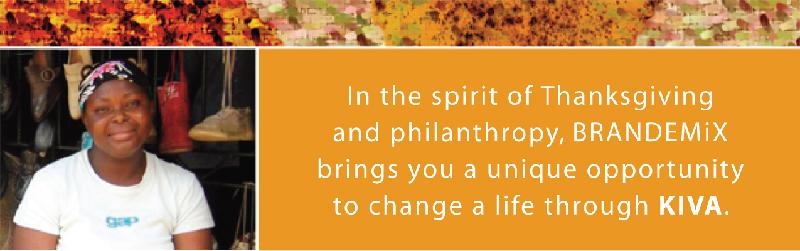
Giving Back at Thanksgiving, with Kiva


All it takes is one person to believe in you.
Organizations across America have believed in Brandemix to develop branded communications that attract, educate, and engage their target audiences.
During this time of year, we feel it’s important to give thanks for that trust and to give back as well. That’s why every year for Thanksgiving we make contributions to Kiva, a nonprofit organization that enables people like you and me to extend microloans over the web to low-income entrepreneurs in struggling communities, whether as far away as Africa or as close as Staten Island and New Jersey.
We chose Kiva out of many other microlending sites because eighty percent of its recipients are women, who are sometimes single-handedly supporting large families. As a certified woman-owned business enterprise, we believe in strengthening women around the world.
No matter how difficult our lives at the moment, people are suffering far more in many places – too many – across the world. Please take the time to visit www.kiva.org and give to the worthy cause of your choice. It’s not charity; it’s a loan, and more than 98% of Kiva recipients repay the loan with interest.
Lending through Kiva creates desperately needed capital in some of the poorest parts of the globe. It bypasses corrupt governments and predatory banks and ensures that the money goes directly to those who will use it. When the loan is repaid, you can give the money to another entrepreneur, donate it to Kiva’s general fund, or simply withdraw it. It’s a great way to give. And while you're there, join the Brandemix lending team.
We hope you’ll join our efforts to fight poverty around the world and here in the US. From all of us here at Brandemix, happy Thanksgiving.

Thursday, November 21, 2013

Employer Branding: Telling The Right Story

Right now, the biggest trend in recruiting is employer branding, crafting the promise your company makes to its employees. And the biggest trend in marketing is brand storytelling, using content, examples, and experiences to bring your brand to life in the mind of consumers.

Combining these trends can bring a powerful presence to your talent acquisition. But it's not always straightforward. Harnessing the best of employer branding and storytelling means sharing not only the story you want to tell but also integrating the story your best candidates want to hear.

For example, your company may have a customer-service focus -- but that's not necessarily part of a compelling employment offer. That sort of disconnection happens all the time: Many employers think that recent college graduates are concerned about the environment, but a recent NACE study showed that working for a "green" company was last on their list of desired employer qualities.

And don't mistake storytelling for content. You may have a regular blog, Pinterest boards full of photos, and a YouTube channel with lots of videos, but if none of it emotionally connects to job-seekers, you won't move the needle. As Momentum Worldwide's Jon Hamm put it in Adweek, "Audiences have always asked for stories. They've never asked for content."

To most effectively integrate storytelling with employer branding, I recommend that the HR department -- and even the C-suite -- become best friends with recruiters, because they're the ones "selling" your company and know what resonates with job-seekers. You'll have to go beyond a few casual conversations, too. Conducting independent focus groups with your recruiters allows you to marry what your company offers with what people want. It also lets you create counterpoints to what people are saying about your company "behind your back."

Another successful hire!


The result? You'll build a compelling employer value proposition that resonates with desirable workers in the job market. They'll be the right cultural fit, too, which means you'll decrease hiring times, hiring costs, and turnover while increasing retention, referrals, and productivity.

The best branding involves storytelling, and employer branding is no different. Good employer branding is easy to spot -- Southwest Airlines, Taco Bell, Deloitte. Bad employer branding...well, those companies never seem to become household names.

It just so happens that Brandemix specializes in brand research and employer branding, so we're an ideal partner for determining what top talent is hearing from your company and what they want to hear. If you'd like to stand out from your competition, I'd love to hear from you. Write to me or read about our successes on the Brandemix website.

Tuesday, November 12, 2013

Branding, Marketing, and Web Design Trends

With the holidays fast approaching (such as Thanksgivukkah in just two weeks!) we thought we'd share some of our branding, marketing and web design predictions for 2014. 

Branding: Clean-Slate Brands
According to Trendwatching, new is good, less is more, and sometimes true is better than tried. Consumers are seeking greater control, choices de-simplified, and upstarts on a mission. 2014 could be the year of the entrepreneur with a great product and an inspirational mission.

Web Trends: Start with Small
Begin your design phase of every project with an eye on how it will look on a mobile device. Then branch out to tablets and PC's. It will help you frame your content by what's important and build an architecture based on best-practice.Less is more. Just as we saw above, the trend is moving to simplification: large images, parallax effects, and one-page websites organized into blocks of content inspired by Pinterest. The only thing that will get more complex is the choice of web-friendly fonts you can use.

Video is surging in popularity. A June 2013 survey conducted by AOL showed that almost three quarters of marketing professionals plan to increase their spending on branded video content or video ads in 2014. Same rules apply: keep it short and simple, and make it good. 

Social Media Marketing: Diversify Your Strategy 
As we saw from investors' show of support for Twitter's IPO, social is only getting bigger and more relevant. As choices expand and audiences fragment, it gives marketing professionals the opportunity to create meaningful content that creates affinity for your brand's voice. Once you build out a brand framework and architecture, drill down your value proposition for each audience and demo you're looking to reach.
  • Google+ will continue to grow in size and influence and should no longer be thought of as a second-tier site. Delete that joke on the famous "Donut List."
  • Image is everything and make it fast. Think Vine, Instagram, Pinterest. The popularity of these sites shows us that appetite for bite-sized chunks of content is growing. Say it in 6 seconds - and go! 
As always, it's best to have a strategy and never too late to download our free Social Media Marketing Strategy Guide

What are your marketing predictions for 2014?  We'd love to hear them. As an agency that specializes in branding, marketing and web design, we love staying ahead of the curve. 

Monday, November 4, 2013

Busting Employer Branding Myths

Considering how important employer branding is, I still encounter a lot of confusion and misinformation about it. So, as a public service, I thought I'd bust some of the myths about employer branding.

Myth #1: Employer branding is unnecessary
Some clients tell me, "We're an employer of choice; great candidates will find us." And yet you never hear executives at Apple or Disney or Coke say "Everyone knows our products; customers will find us." In fact, those brands have massive marketing budgets. You can't assume that your exact desired demographic, whether it's MIT grads or truck drivers, will actively seek you out. Or think about this: What if great candidates do know you -- and don't like what they see? Employer branding can increase awareness and engagement by refocusing your messaging on your company's mission, vision, values, and business strategy.

Myth #2: Employer branding is expensive
Good employer branding actually saves you money, through lower recruiting costs, higher engagement, and increased productivity/sales. Depending on the plan goals, a basic research project can be launched for as little as $10,000. You can start small with communication audits and internal surveys, and then add executive interviews and employee focus groups. If you can secure a larger spend, we recommend surveying external constituents to provide context to your internal findings. 


Myth #3: Employer branding is completely separate from consumer branding
It better not be! An employer brand must be absolutely aligned with and inspired by the consumer brand. After all, candidates are customers, investors, and influencers. One of the first things we do on any employer branding project is break through organizational silos and align the employer brand with the company's current messaging. We try to get all stakeholders -- Marketing, HR, Internal Communications -- into the same room to make sure we have a consistent brand that's authentic on both sides of the house. Along the way, we often help Marketing and HR become friends!

Myth #4: Employer branding research can be done in-house
It can, but it's much more difficult. Employees are reluctant to share their true feelings with their HR department for fear of reprisal. Executives interviewing each other often leads to an "echo chamber" effect, where no one advocates change. And external constituents, such as customers and former applicants, think surveys are a marketing ploy and stay away. Brandemix is a neutral third party; we take empathetic listening to the next level by listening, probing, and processing. An outside set of eyes can reveal things about your employer brand that you never saw.


Myth #5: Employer branding only helps the hiring managers
Au contraire! The entire company benefits from a strong employer brand. You'll attract employees who are a good fit for the culture, who stay longer, perform better, and recommend the company to others. More referrals and lower turnover makes for a happier, more stable workplace. HR will have more time to work on other initiatives, like workforce planning, talent management, or diversity. Eventually, you'll have weeded out the underachievers and filled your roster with satisfied employees, which studies have shown create more profit for the entire organization.

Don't let these myths fool you. Employer branding is crucial to the success of any company, from a nonprofit to a regional chain to a global corporation. It cuts costs, generates profits, and can turn your company into a true employer of choice.

Any other myths you want busted? Drop me a line.